
Hyundai i30 (PD): Smart cruise control (SCC) with stop & go system / Smart Cruise Control Vehicleto- Vehicle Distance
To set Vehicle-to-Vehicle Distance
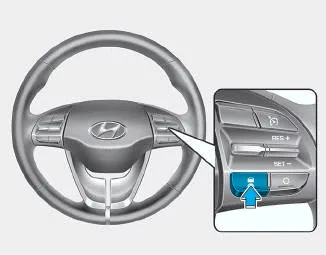
When the Smart Cruise Control System is ON, you can set and maintain the distance from the vehicle ahead of you without pressing the accelerator or brake pedal.
Each time the button is pressed, the vehicle to vehicle distance changes as follows:
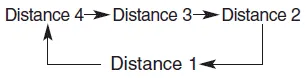
For example, if you drive at 56 mph (90 km/h), the distance maintain as follows:
Distance 4 - approximately 172 feet
(52.5 m)
Distance 3 - approximately 130 feet
(40 m)
Distance 2 - approximately 106 feet
(32.5 m)
Distance 1 - approximately 82 feet
(25 m)
Information
The distance is set to the last set distance when the system is used for the first time after starting the engine.
When the lane ahead is clear:
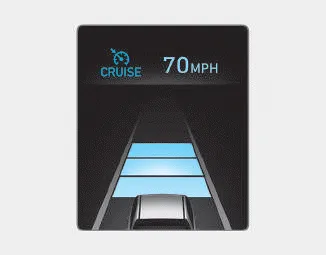
The vehicle speed will maintain the set speed.
When there is a vehicle ahead of you in your lane:
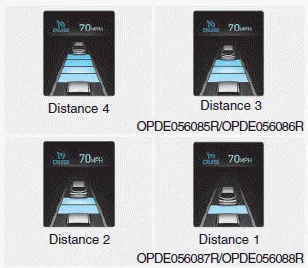
- Your vehicle speed will slow down or speed up to maintain the selected distance.
- If the vehicle ahead speeds up, your vehicle will travel at a steady cruising speed after accelerating to the set speed.
WARNING
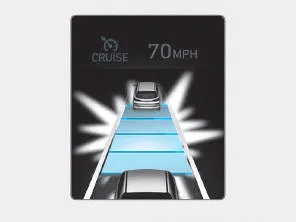
When using the Smart Cruise Control System:
- The warning chime sounds and the Vehicle-to Vehicle Distance indicator blinks if the vehicle is unable to maintain the selected distance from the vehicle ahead.
- If the warning chime sounds, depress the brake pedal or use the steering wheel to actively adjust the vehicle speed, and the distance to the vehicle ahead.
- Even if the warning chime is not activated, always pay attention to the driving conditions to prevent dangerous situations from occurring.
- Playing the vehicle audio system at high volume may offset the system warning sounds.
CAUTION
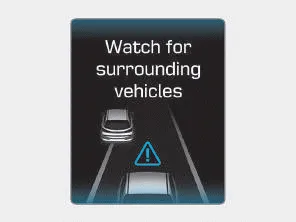
If the vehicle ahead (vehicle speed: less than 20mph (30km/h)) disappears to the next lane, the warning chime will sound and a message "Watch for surrounding vehicles" will appear. Adjust your vehicle speed for vehicles or objects that can suddenly appear in front of you by depressing the brake pedal.
Always pay attention to the road condition ahead.
In traffic situation
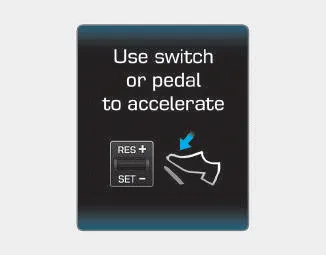
Use switch or pedal to accelerate
- In traffic, your vehicle will stop if the vehicle ahead of you stops. Also, if the vehicle ahead of you starts moving, your vehicle will start as well. However, if the vehicle stops for more than 3 seconds, you must depress the accelerator pedal or push up the toggle switch (RES+) or push down the toggle switch (SET-) to start driving.
- If you push the advanced smart cruise control toggle switch (RES+ or SET-) whilst Auto Hold and advanced smart cruise control is operating the Auto Hold will be released regardless of accelerator pedal operation and the vehicle will start to move. The AUTO HOLD indicator changes from green to white. (if equipped with EPB (Electronic Parking Brake))
To set Smart Cruise Control speed 1. Push the button on the steering wheel to turn the system on. The cruise () indicator will illuminate.
The Smart Cruise Control uses a sensor to detect distance to the vehicle ahead. Warning message SCC (Smart Cruise Control) disabled. Radar blocked When the sensor lens cover is blocked with dirt, snow, or debris, the Smart Cruise Control System operation may stop temporarily.
Other information:
Hyundai i30 (PD) 2018-2024 Owner's Manual: Check tyre pressure
You can check the tyre pressure in the Assist mode on the cluster. Refer to the "LCD Display Modes" in chapter 3. Tyre pressure is displayed after a few minutes of driving after initial engine start up. If tyre pressure is not displayed when the vehicle is stopped, "Drive to display" message will appear.
Hyundai i30 (PD) 2018-2024 Owner's Manual: Owner maintenance. Owner maintenance schedule
WARNING Performing maintenance work on a vehicle can be dangerous. If you lack sufficient knowledge and experience or the proper tools and equipment to do the work, we recommend that the system be serviced by a HYUNDAI authorised repairer.
Categories
- Manuals Home
- Hyundai i30 Owners Manual
- Exhaust System (DPF) Warning Light. Glow Indicator Light
- Brake/clutch fluid
- Warning and indicator lights
- New on site
- Most important about car
